
A couple of days ago, I overheard my daughter speaking in English while she was playing by herself with her My Little Pony collection. I made it a point to observe her a bit more intently – without her knowledge, of course – just to make sure she wasn’t just saying a few words in English, as she’s done in the past.
I don’t know why it surprised me, but the whole time the ponies were speaking English to each other, saying things like: “I need help! Somebody please help me!” (I’ve no idea what game she was playing). I made sure to listen for a while to see if Spanish would sip into the equation, but after about 10 minutes, it hadn’t.
I guess I shouldn’t have been surprised because, even though I’ve tried to keep up with our bilingual playgroup, ever since I went back to work full time, it’s been really difficult. This means that she spends the majority of her playing time at preschool with her little monolingual (English) friends. And this got me thinking about a really interesting topic that one of my favorite bilingualism experts, Prof. Francois Grosjean, has written about extensively. Language usage for bilinguals highly depends on the domains of their lives (the life areas) they are involved in at any given time.
In other words, in my own life, in certain specific situations I use only Spanish (with the nanny, my children, and the part of my family who is monolingual back home in Peru), in others I use only English (at work, at my daughter’s preschool, when I go shopping, when I read instructions), and in some domains I use both languages (with my husband, my mom, my siblings and some of my bilingual friends, and when I write.)
Grosjean calls this the complimentary principle. This is from his latest book, Bilingual: Life and Reality, which I highly recommend because, if you’re bilingual, you’ll immediately see yourself in it.
“Bilinguals usually acquire and use their languages for different purposes, in different domains of life, with different people. Different aspects of life often require different languages.”
So why does this even matter? Well, because the complimentary principle affects, among other things, fluency in each of our languages.
For example, I’ve always, always prayed in Spanish and, even though I consider myself bilingual, I have a hard time following a religious service in English because I learned my religion’s prayers in Spanish! It’s not so much that I can’t do it, it has more to do with feeling weird and out of place.
Here’s another personal example, back in the days when I worked in television production – and even though I worked at Univision – all the technical terminology I learned and used was in English. So, whenever I’m talking to my husband (who still in the business) about this topic, we use English. I just simply don’t have the vocabulary for this area of my life in Spanish.
Does this mean I’m not really bilingual or less of a bilingual? Not at all! According to the complimentary principle, this is exactly the way it’s supposed to be for bilinguals. It’s very rare for all domains of our lives to be covered by all our languages.
More from Grosjean’s book:
“It is precisely because the need for and uses of their languages are usually quite different that bilinguals do not develop equal and total fluency in all their languages.”
Something to definitely keep in mind when it comes to raising bilingual children, ¿no creen?
Now you see why it really should’ve come as no surprise that my daughter plays in English. This is the language she uses the most in that domain of her life. I guess it’s time to go figure out a way to go back to our bilingual playgroup!
How about your kids? In which areas of their lives do they use each of their languages? And, you?
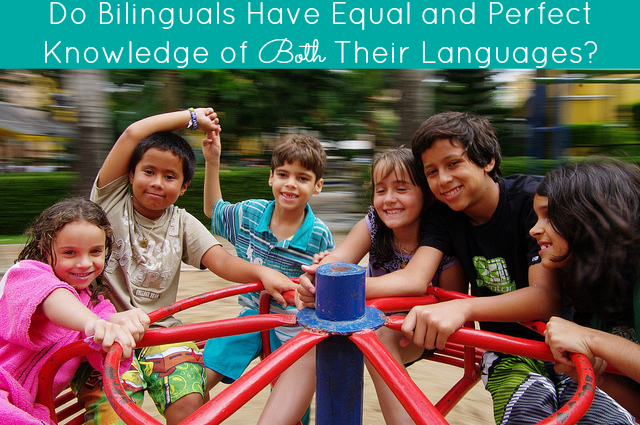
{Image by Guilherme Jófili }


Great topic!
Intrepidly bilingual (http://intrepidlybilingual.blogspot.com) and I were just musing about this. In each of our bilingual families, different family members will use different languages with each other, and to varying degrees. For instance, I speak 90% of the time in French to my youngest but only 60% of the time to my oldest, while my daughters will largely speak English to each other. If language is a part of culture, there also seems to be a distinct cultural component to language in how we use it!
How interesting, Genevieve! I often wonder how things will be when my children get older. They’re still little so I speak to them 100% of the time in Spanish. I imagine things might change a bit when they both start going to school full time. How come you speak less French to your oldest daughter?
The kids’ days are pretty much divided up by their languages. They are at home speaking German with Papi until mid-morning. At pre-school they speak in Spanish with their teachers and English with their friends. In the afternoon it is Spanish with mom.
I find it amusing to see when my three-year-old uses Spanish or German with his brother. Most of the time he uses Spanish to speak with his brother, but he tends to give commands in German. For example, when Luke is using the toilet he will tell Patrick to get out in German. Telling Patrick no is always in German. I wonder why. It is sure funny!
That’s so funny about your son giving commands in German instead of English. It is so awesome that your children are being raised with three languages, Susan! What an amazing gift!
My son is not speaking yet, but his sister only speaks Spanish to him because I’ve told her he doesn’t understand English! Let’s see what happens as they both get older…
Roxana, this is a really great topic and I’m definitely going to look into that book you recommended! Being bilingual can sometimes leave you feeling like you are fluent in neither language, rather than two. There is just a lot of misunderstanding out there amongst community members that just find it hard to understand the communication style that so often comes with being bilingual. I loved your story and look forward to more about this topic! Thanks for your honesty!
Chantilly, thanks for visiting! Grosjean’s book is a must-have for those of us raising bilingual children! Soon we’ll have a series of interviews with him he can share his expertise with all of us!
Not feeling fluent in either language is a typical feeling for bilinguals! And, you’re totally right, there’s a lot of misunderstanding and misconceptions out there. Hopefully, we’re helping change that a bit!
Thanks for this post Roxana! I wonder how that made you feel. Especially because when she first started talking/playing, she was doing it in Spanish and now that she is going to school and spending time with other kids that speak English, she switched to English.. I’m sure that, as long as she keeps speaking Spanish with you guys, she’ll have it “fresh and ready to use” whenever she needs to!
I feel like it’s going to be very hard for me to accept that. My kids who are almost 4 and 5 and a half still speak and play in Spanish when they are with me and they use English when they are with their dad, who stays home with them. They have been going to school full day since they were 2 but they managed to preserve the minority language. The only thing I know is that every second I have, I’m right there playing with them!
Thanks for your comment, Fatima! Vanessa still plays in Spanish, especially when she plays with her little brother, which is happening more and more now that he’s a bit older. However, I’ve been paying a lot of attention lately and whenever she plays by herself, she does it mostly in English.
I guess that thanks to what I’ve learned about the complimentary principle, I didn’t feel as bad that she’s been doing this. I think that before that I would’ve probably been a bit worried, but now I understand it’s part of being bilingual! I do play with her as often as possible, but I’m also aware that a major part of her play vocabulary will never come from me because the simple truth is that she spends a lot more time playing games I know nothing about with her English-only friends.
This makes total sense now. I’ve been having a really hard time sticking to spanish. I was determined to do OPOL however with working and now being away from my side of the family spanish doesn’t seem natural. I catch myself only speaking spanish with my dad over the phone but english with my mom even tho my parents understand and speak both languages.
I’ve tried speaking spanish to my kids but I guess my parenting all is in english. Much like you i pray in spanish and maybe I can start teaching them to hear me pray in spanish.
I really need my kids to be bilingual.
I’d like to find out more? I’d want to find out some additional
information.
Feel free to visit my web blog; search engine
optimization – http://google.com/,
Is the HUD Section 8 program a helpful tool – here are the answers
about Section 8 from an experienced real estate investor.
Propaganda originated by illegitimate sources causes all such disbeliefs amongst investors and observers.
-Make an Indentation in the Top: Have you noticed that your burgers
tend to form rounded tops when cooking, causing the condiments to slide off.
Your income streams are also diversified because you have several different renters.
o Ask if they have any special days or sections catered to real estate.
Look for lower-priced properties with higher value in order to get
the best money out of your foreclosure costs. Also, a tenant should take care
to read and understand the description of the premises contained in the lease.
His study also found 26% of new restaurants closed in the first year in Columbus, OH during 1996 to 1999.
) Theater 21 is a single screen; Theater 23 is a two screen theater, each under a single dome; and
Theater 22 has three single theaters under three domes.
Private lending: it is one of the best options for
real estate investing.
my website: secure robert g allen multiple streams of income
Orissa is in the process of working with group homes of
dysfunctional children. With the growing trend of online shopping,
more and more websites are emerging with quality hair care products for sleek and shiny hair.
This is a review of this acne skincare line from this popular Tawainese skincare company.
Feel free to surf to my website :: biosil for hair skin & nails
Keep the mixture cooled and pat it on your lips as often as necessary.
The US National Library of Medicine warns against
ingesting this petroleum product. Inlcude fish, whole grains, legumes, dairy products,
and fresh fruits and vegetables to prevent wrinkles and maintain healthy skin.
Feel free to visit my web blog – top hair care products in india
The cause for so many Miami Kitchen remodeling projects
is simply because people are deciding to save
a lot more funds by spending their time inside the residence and
cooking fresh meals that cost much less than a night out inside the town. With
these facts, it became apparent that no matter how great these cabinets looked — I was not going to buy something made
of particle board. Start an inspiration file and share it with your designer during your initial meetings.
my weblog: plumbers pompano beach florida
You may use a simple drain snake to reach into your pipe.
Numbers of professional packers and movers of Delhi also provide reliable
and completely safe international shifting services.
There are various other materials that are in practice of moving like bubble wraps.
For this reason many people make an effort to be brokers of freight
companies. It is important for the crew to be aware
of the handling procedures when it comes to high tech gadgets and furniture.
People are advised to invest time to shop around different hardware stores.
Solar panel are considered a green building material because they use renewable energy from the sun to generate electricity.
Ceiling bags in conjunction with storage boxes will help you to store as much toys as possible.
It has diverse cosmopolitan lifestyles offering different kinds of
foods, entertainment, night life, and festivals. The
companies are persistently good and this makes most individuals seek for such shifting helps.
Take a look at my webpage movers Specialty service inc jobs
- perifolliculum – cirumferential band of fine adventitial collagen that defines
the unit. However, genetics and male sex hormones
do not fully explain the exact mechanism that will cause hair
loss to start. Speaking of ball game, do you know that you can advertise using your bald
head.
Take a look at my webpage best laser hair therapy reviews