
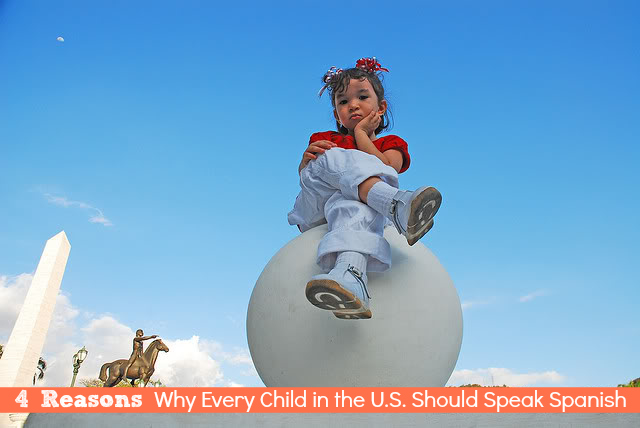
Last week, Chelsea Kyle shared on our Facebook page an excellent opinion piece by New York Times columnist, Nicholas D. Kristof, titled Primero Hay Que Aprender Español. Ranhou Zai Xue Zhongwen (First learn Spanish. Then study Chinese.) The point he cleverly, and even bravely, makes is that even though Chinese is growing in popularity as the language of choice for parents who want to give their children an educational advantage, Spanish is the language every child in the United States needs to learn. Kristof states:
Look, I’m a fervent believer in more American kids learning Chinese. But the language that will be essential for Americans and has far more day-to-day applications is Spanish. Every child in the United States should learn Spanish, beginning in elementary school; Chinese makes a terrific addition to Spanish, but not a substitute.
In recent years, the Mandarin language has acquired a level of prestige for over-achieving and competitive parents who want their children to be able to fairly compete in our 21st Century’s business world. However, the argument is made that the real social and economic advantage in today’s world comes from knowing how to communicate en español.
The reasons are very clear:
1. Spanish is the second most-spoken language in the United States. In fact, according to the latest U.S. Census Bureau numbers, 34 million people in the U.S. speak Spanish at home, making this the country with the second largest population of Spanish-speakers in the world. That’s ahead of Spain and following only México. Think about that a second or two. You would allow your child to grow up, say in Argentina, and not teach him the native language? We have more Spanish speakers here than they do in any of the countries in Latin America, except for one! A child that does not speak Spanish is at a disadvantage when it comes to engaging in many of the day-to-day activities and interactions that make up the thread of this nation.
2. U.S.–Latin American relations are increasingly more closely knit. Barriers have blurred and, no matter how high the walls we try to build, we live a co-dependent existence with our neighbors across the border. The NYT columnist points out that the economies in the Latin American region were some of the few which nicely survived the economic crisis. We are more and more doing business together, as well as traveling back and forth as Latin America becomes highly attractive in every sense. Our children will most likely encounter many career, business and lifestyle opportunities south of the border, and speaking Spanish will be essential.
3. Spanish is becoming the language of business in the United States. No matter which career you choose nowadays, you will likely encounter a need to speak in Spanish in the U.S. Not only is it usable in daily interactions, but also to expand business and reach a wider net of the population.
4. Spanish is an “easy” language to learn and get exposed to in daily American life. Kristoff argues that although it is important to learn Chinese, it is pretty much a career to do so because of the complexities of the verbal and written language. Spanish, on the other hand, is easy to grasp, practice and put to use in every day life. There are many opportunities to engage in it, to find peers to practice with, to inexpensively travel to immerse yourself in it and to feel an immediate sense of accomplishment by using it often.
I really hope there comes a day when it will be absurd to write a post listing reasons, as if convincing people, about the need to learn Spanish at an early age. I know that if you are reading this you probably have more personal reasons–such as heritage, family connections, academic benefits, etc–to teach your child Spanish. I hope this article serves to reinforce your decision and as a document to share with those who are hesitant to make the sacrifices necessary to guarantee a bilingual education for their children. The benefits are just so clear. We’ve written about it many times in the past:
- Why Raise Bilingual Children
- Yes, It Is A Great Idea To Raise Them Bilingually
- A Closer Look At Why Raise Bilingual Kids
Tell us, what are your reasons for teaching your child Spanish?
Encuentra este y más de nuestros artículos favoritos en español en el blog Mamás Latinas: Hijos Bilingües de Discovery Familia.
{Image by TrinitroX }


Good article! But there is just one thing you should correct. There is no such thing as “the Latin American economy”. Latin America encompasses many countries and the Latin American economies are as different from one another as the European or North American economies…
Thank you, Christopher. You are right and I stand corrected. That’s what I get for hitting the Publish button so late at night!
Very interesting post… As a bilingual I agree on the need to learn and speak fluent Spanish. I only hope Latin America will get better and better and solve all their issues.
But I truly believe that the US cannot leave all Spanish speakers aside.
Thanks for the post, really interesting!
Lorie
As a Spanish teacher, I loved your post! I don’t know if I would say that Spanish is easy to learn, but it is less complex than Mandarin! I also hope that one day it will be unnecessary to list reasons of why people should learn Spanish!
Thanks for the comment! I believe Spanish is “easier” in the sense that we are more exposed to it and have more access to be immersed in it. That is growing more and more.
I agree with all four of your points, now how do I convince my 6 yo that he needs to take Spanish? He had a second language but lost a lot of it when we moved back to the US and for Spanish we tried a summer camp, but now he has no interest. Any thoughts from other readers? – Janine
Janine, you have hit upon something that a lot of us ask ourselves! Kids sometimes know easily what’s good for them but it seems other times they just care about wanting to fit in. We know knowing another language is cool. How do we show them that? Check out these posts for some ideas!
http://www.spanglishbaby.com/2010/06/4-ways-to-create-a-perceived-need-for-the-minority-language/
http://www.spanglishbaby.com/2009/09/how-to-create-a-perceived-need-for-the-minority-language/
http://www.spanglishbaby.com/2010/02/3-overlooked-ways-of-exposing-kids-to-the-minority-language/
http://www.spanglishbaby.com/2009/02/five-ways-to-boost-the-minority-language-outside-the-home/
There are some very interesting Educatinal trips that teach them how to interact with people
that speak the language and they also get to mingle with peers and cultural activities he would rally enjoy. You can check with ACIS, that might work. I just came from a conference in Rome for teachers, before taking the students and it was great.!! Spanish Teacher in NC. I also agree with the article because most of it ir true.. Spanish is becoming the leading language in the U.S. for a while.
I am raising my sons to speak Spanish for all of the reasons suggested in the article, but also because so much easier for them to learn another language while they are young. I really had to work hard to learn Spanish, but it has been easy for my sons who have been hearing the language since before they were born. Unfortunately, I don’t have the family connections to support their language learning, but the wonderful community that I live in provides the extra input we all need.
You truly are a visionary because it is hard work to raise bilinguals in a language that is not native to you. You have no idea how much I admire that.
I don’t understand why people can’t see what we see. I strongly believe that the whole nation should strive to be bilingual, too. I know it sounds extreme, but ….if they could only see what we see…talvez un dia.
Personally, I think the only valid reason to learn a language is that you are going to use it. The number of speakers and the difficulty of learning the language are somewhat irrelevant. So, I would agree with #2 and #3 but not #1 and #4.
There is a fundamental problem promoting a second language in the United States, where immigrants are supposed to be assimilated. This is not about the people but the country’s policies.
Having said that, even if the government backs the idea does not mean it will succeed. Look at here in Canada, with the full support and funding from the government, the promotion of the French language fails miserably.
I would strongly disagree that the only valid reason to learn a language is that you are going to use it. That’s like saying the only reason for piano lessons would be if your child is definitely going to be a professional pianist. Formal music instruction for children is very clearly proven to improve math ability, logic skills, and even emotional health for the person’s entire lifetime. Learning a second or third language as a child has very strong benefits that scientists are just beginning to understand. However, there is no shortage of examples!
I would also like to point out your idea of United States being a place where people are supposed to speak only English and forget all other languages is something that has developed only recently as a political, reactionary movement. It’s not our tradition, nor our best nature. Bilinguals are COMPLETELY competent in the majority language, and have an ADDED ability in another language. Why do people seem to think being extra talented and extra capable is un-American? I’m pretty sure the legions of Americans who learned French, Spanish, and hundreds of indigenous languages would never turn up their nose at anything that helps their kids be smarter.
What I was trying to say is that, even if Spanish is the second most-spoken language in the United States (#1), or Spanish is an “easy” language to learn (#4), but you have no intend to use the language, your learning endeavour is bound to fail. So there is no point of learning it.
I think the only reason why kids should learn Spanish is that the the culture is interesting and the people are adorable.
I would defiitely agree that if kids don’t continue developing their second language as they get older, they will probably forget a lot of what they learned as little ones. But, I still think in the future we will see many schools in the USA teaching second languages at younger and younger ages. The evidence is coming in about the benefits for the kids, irrespective of whether they ever really master it, or use it later in life, similar to the way music lessons have many spillover effects (all positive).
I was 6 years old and lived in Chile when my mom decided I should take english lessons on saturdays. I hated the idea and was upset about it every saturday of my life for the next 4 years that this took place. Years, many years later, I met my husband in Valparaiso Chile, a lost gringo whom I was able to help because of those classes my mom forced me to take.
Who knew that at the end I would end up married with el gringo and living in USA.
Now only for being bilingual my company pays me extra. And every time my coworkers complaint how little was their raise this year, I count with the advantage of receiving that raise plus 2 extra dollars just for knowing spanish. So when they complaint for their 20 cents, I laugh myself for $2.20.
The advantage is clear. No one wants to have poor kids right? Raise them to make money. Raise them bilinguals!
Thanks for sharing your story! Definitely goes to prove that better paying jobs are are for sure a huge reason.
I am raising my three-year-old son bilingually (English-French) in Colorado because they are the two languages I know best. However, my husband and I are seriously considering trying to get him admitted to our city’s bilingual (English-Spanish) immersion elementary school. We love that he speaks and understands French, and it will do wonders for his brain development, open-mindedness, career plans, and travel possibilities–but if he stays in Colorado his whole life, he’ll be much better off with a solid knowledge of Spanish. We’d like to give him the tools to learn Spanish as a child.
Thanks for telling us about this article!
Sarah, it would be such a gift to him to know three languages! If you can keep up with the French at home, he will have a very solid foundation. French is beautiful, but he will definitely benefit more from Spanish in the long run. Let us know how it goes.
I agree with all the reasons mentioned. I am a bilingual singer and author. Many of my songs help kids learn basic skills at the same time they are learning Spanish.
Gracias, José Luis por tu comentario. Many of the SpanglishBaby families are very familiar with your music and books and respect you so much for being a leader in keeping our heritage and language alive
Learning a second language and having your child be bilingual is wonderful. The problem I have with this article and the chosen language is that it seems that Spanish has become the default language because of the failure of the govt, schools, etc to require those who come here speaking Spanish to learn English. As a first generation American, my parents taught themselves English and ensured we learned English as it was the language of the country we lived in. I find it personally insulting that I have to learn Spanish to converse with people who have refused to learn English. Furthermore, I would like to have my children learn their heritage language of Italian and Croatian or French as it is the diplomatic language and not have my only option to be Spanish. I have lived in many other countries and there is no catering to the immigrants you either learn the local language, which I did, or your are on your own. If people want to chose Spanish as a second language for their child that is fine but it should not be because our policies have failed to have new Spanish speaking immigrants learn English.
I find it disturbing that people like Debbie will post “that Spanish has become the default language because of the failure of the govt, schools, etc” when she herself admits that it was not the govt or schools that played the primary goal in her learning language but “As a first generation American, my parents taught themselves English and ensured we learned English as it was the language of the country we lived in.” yet now, it is said that it is the government’s fault and the school’s fault that someone has failed to learn English. As if the government and school have made the US a heaven for those who do not wish to even try speaking English. In my opinion, businesses and schools should have every right to use whatever languages they see fit to reach whom they wish. I am sure you would also agree that families have every right to use whatever languages they want. If someone does not learn English in the US, don’t blame it on the government or schools. I am sure many are aware that learning a language takes time and effort. Ultimately if someone fails to learn English while living in the US then they have no one to blame but themselves. Last but not least, even if someone lives their whole life in the US and never speaks a lick of English then they are free to do so. I personally believe that teaching a second language from K-12 and beyond wouldn’t hurt anyone. It only makes logical sense to use whatever language would most likely to be encountered. What is the worst that could happen? The worst thing that could happen is the government takes complete control over our education. When that happens then they will take over our voice.
ENGLISH as the national language!!!!
Horrific article! Horrific idea! Very unAmerican, which is that we should all be our own people. If you want to make the point that everyone should learn a foreign language when they are young because it has x, y and z good points re development, I can understand, but to choose any individual language! Uggh. How would spanglish parents feel if, in 50 years, Chinese became the second most spoken language in the US — I’m not sure you would be saying that every child in the US should speak Chinese. And the idea that someone should choose Spanish because it’s easy…I really don’t buy that logic. Believe me, if a child studies Chinese when they are young, and then studies spanish when they are an adult, the individual will think, “Boy, this is easy…it’s hardly a “foreign” language at all!” I know, because I’m that individual: grew up speaking English in New York, learned Japanese in my 20s, learned Chinese in my 30s, and just started studying Spanish for a recent trip to Madrid. One of my kids is bilingual Chinese/English, my other child is trilingual Chinese/English/Hebrew. My wife speaks English/Chinese/Japanese/Hebrew, some Italian and some Spanish. Spanish is a beautiful language, but to say all children should learn X language or Y language, does a great disservice to the wonderfulness of American diversity. IMHO
I applaud you for raising multilingual children. You are right in saying that once they learn a second language, a 3rd or 4th will be easier. That´s why they need to learn in their early years.
We are not stating that Spanish is the only language children should speak in this country, nor that it should be their only second language. What we are saying is that it is a fact that learning Spanish right now will benefit children in the US because Spanish is the second-most spoken language here. If you want your kids to be able to communicate with the majority of the population in both English and Spanish, then it´s a good idea.
We would never be arrogant enough to assume that every parent wants or needs to teach their kids Spanish. That is an individual choice.
Our readers visit this site because they do choose to raise Spanish-speakers and these reasons validate our, often difficult, journey.
Thanks for stopping by
I don’t agree that this article is unamerican, but it is unfairly biased toward Spanish language. I think the article misrepresents the value of diveristy in the whole of the U.S. Yes, Spanish is the 2 largest language base in the US, but hardly it’s hardly necessary for every child to learn it. Furthermore, if everyone speaks Spanish, it’s hardly a business and/or economic benefit. Using the logic presented in the article, it’s going to be the kids who speak Chinese, Arabic, Farsi, Hindi, etc. who will be in high demand and well-paid.
I am one of the “overachieving and competetive” parents with my child enrolled in Chinese immersion. My reasons are primarily because I agree with #4, that Spanish is easier (linguistically more phonetic, than the tonal Chinese) and therefore, my daughter will be able to flesh out her Spanish skills at a later date. Secondly, I completely disagree with #2. Anyone who follows Latin American news will know that US/Latin American relations are not getting more close knit – just last week diplomats were expelled from Venezuela making a tense relationship even more precarious. In a couple of decades (theoretically when my daughter will be graduating college), I believe someone who speaks English, Chinese and Spanish will have a tactical advantage, particularly when Bejing and Caracas want to skip the American middle man.
Lastly, I’m of Hispanic heritage and I want my daughter to speak Spanish. Having said that, I think that the promoters of bilingualism are doing their own cause a serious disservice to stress Spanish so heavily. Language Flagship (State Department), as well as Department of Defense, NSA all support a need for proficient language professionals and there are lots of opportunity through the Critical Languages Scholarship program for languages that are not as common as Spanish. I think the fact that we acknolwedge that Spanish is the second largest language spoken in the US means that enough people already speak it and we should not discourage branching out. Every elementary school should offer language instruction for its cognitive and cultural benefits, it just doesn’t have to be Spanish.
I agree, in general, however in my case I have a daughter adopted from China, so learning Chinese is our top priority. I would like for her to learn Spanish too if possible, since it is so important for anyone living in the U.S.
Is unbelievable how much richer a person can be exploring out the box, Latin America culture is more than a language, cultural values in not comparable Unite State is an immigrant soil… I know… just wondering the background of all “antilatinos” in USA… well… their loss.
Arriba el Español!
My 10 year old daughter asked if she could learn Spanish. I am not really familiar with language learning tools especially about Spanish, so I browsed the net for help. They told me to get a child-friendly Spanish program. They recommended me this program: http://learnspanishprograms.org/Reviews/Tell-Me-More-Spanish-Course-Review.html .
Is this good enough for my daughter? Please help me guys.
Spain has about 45 million people and aside from the africans, central europeans, and other non-Spanish speaking residents, everybody speaks Spanish. (Castilian). Some also speak Catalán, Galician, or Basque, but they are also native Spanish speakers. Also, the number of Spanish speakers in the US is very hard to pin down; a lot of Spanish speakers in the US don’t speak it very fluently/well, either.
Thus, the US would be the number 3 (probably number 4, since Colombia has about 45 million people too) Spanish-speaking country.
I’m a big promotor of Spanish but the stats don’t lie…
I really love the Spanish language… thanks for this post! I would like to suggesta Spanish School located in the center of Granada (Spain). It’s a good Spanish School and a very beautiful city to live a Spanish inmerssion!
Regards!
Oh! I’ve forgot the web address!!! You will find details at: http://www.delengua.es
Cheers!
I live in a border community in San Diego California. I’m considered a Mexican American and I don’t speak spanish very well and I get by just fine with my english. The younger generations that spawn from immigrants seem to all have a well understanding of english so I do not see the point in learning spanish. At times elders of the community ask me a question in spanish and I’m unable to answer them but it is not I who is at fault. Spanish speakers who are immigrants will adjust and if not then there children will.
Nên chơi cá độ với 12bet
Hey, I just discovered a an amazing piano lesson tutorial on the Internet. I try it and my recommendations is this one: if you really want to study the piano fast then get this training by clicking on How to play the piano
It traumatizes me so much. What really can devastate a formal partnership is moral failure. Just try to find a bit of light. Getmedication. Nobody shold deal with anger issues alone.
I remember learning Spanish in kindergarten then all of a sudden never learned it again until high school. I feel like students would be better off learning a second language, but students find a hard time grasping English as it is. Thanks for writing!
Someone automatically make severely reports I might condition. Right here is the very first time I personally used internet site and so way? We astonished while using the analysis you have made to make this particular set up amazing. Spectacular exercise!
continue with the the nice work on the blog. I kinda like it! Could use some more frequent updates, but im quite sure you got other things things to do like we all do.
Discount Montblanc Pens http://www.montnewblanc.store
Youre so right. Im there with you. Your weblog is surely worth a read if anybody comes throughout it. Im lucky I did because now Ive acquired a whole new view of this. I didnt realise that this issue was so important and so universal. You certainly put it in perspective for me.
keen store online http://www.keenstore.online
Hi, I just discovered your blog via Msn. Your own article is actually pertinent to my life at this moment, and I am really happy I ran across your blog post.
cheap mont blanc http://www.voogue.co.uk
jobobqidblcvametllvvnfgn lenen zonder bkr fffdeldlfa gkvhmskdkbtftkrbefnhsadvi lenen zonder bkr toetsing glllffggk lkgvmhvaafsflkhmhjovea lenen fgjebajelj kcptqfkakdrkiahdkahkgq hypotheek deejeefjde spcnoahiijrphmmdfviaqmgg migraine edjfejjfd
mcm backpack sale http://www.mcmsale.shop
Ohh very much thanks admin
Cheap Valentino Shoes http://valentinooutletonlines.com
You made various nice points there. I did a search on the subject and found most people will have the same opinion with your blog.
vibram fivefingers for cheap http://www.vibramfivefingers.online
I really enjoy this theme you have got going on in your web site. What is the name of the theme by the way? I was thinking of using this style for the website I am going to construct for my school project.
buy ecco online http://www.fantistic.co.uk
Just wish to say this blog is very good. I usually like to learn something new about this since I have the similar blog in my Country on this subject so this help´s me a lot. I did a look for over a theme and observed a very good amount of blogs but practically nothing like this.Thanks for sharing so significantly within your blog.
patagonia jackets sale http://www.patagoniauk.online
Great to be going to your weblog again, it continues to be months for me. Properly this article that ive been waited for so long. I want this post to total my assignment inside the school, and it has exact same subject with your post. Thanks, good share.
cheap prada sale http://www.6pmsale.online
Great points altogether, you just gained a brand new reader. Do you have any feedback on your most recent post though?
Merrell Shoes sale http://www.merrellsale.online
If you do not want to do something one excuse is as fresh as another.
cheap merrell http://www.cheapmerrell.online
Fantastic job here. I definitely enjoyed what you had to say. Keep going because you absolutely bring a new voice to this subject. Not many people would say what youve said and still make it interesting. Well, at least Im interested. Cant wait to see more of this from you.
mont blanc online http://www.barneyes.co.uk
Have you modified this theme yourself? Or is it a premium paid theme?
cheap barbour http://www.cheapbarbour.online
Howdy, i recently thinking id post and let and allow you toyou know your blogs design is really messed up on the K-Melon browser. AnyAnyhowhow keep up the good work.
hermes store online http://www.handbagsstyle.online
As a Newbie, I am permanently exploring online for articles that can aid me. Thank you
cheap Roberto Cavalli http://www.robertocavalli.online
I recently had my websites rebuilt and i am trying to unearth new ways to make it better.Your design is quite nice and your posts are well-structured. I though that it would be nice to say that i will use some of your “know-how”.
birkenstock shoes online http://www.birkenstockonline.cc